 RANZCP homepage

President’s update: Reflecting on 80 years of RANZCP
9 Oct 2026
President's message
Today marks 80 years since 67 psychiatrists from across Australia and Aotearoa New Zealand came together to establish the Australasian Association of Psychiatrists.
An 80th anniversary is an opportunity to celebrate what has been built, but also to think about what it means to inherit a profession and a College shaped by generations before us.
For me, that is ultimately a question of stewardship.
We inherit knowledge, institutions and professional standards that others worked hard to establish. Our responsibility is not simply to preserve them, but to keep strengthening them: to retain what remains valuable, question what needs reconsideration, and leave psychiatry stronger for those who follow us.
Our story began formally on 9 October 1946, when the Australasian Association of Psychiatrists was established in Melbourne with 67 Foundation Members. Education soon became central to its purpose, with the development of formal psychiatric training during the 1950s. In 1963, that work took another step forward with the incorporation of the Australian and New Zealand College of Psychiatrists.
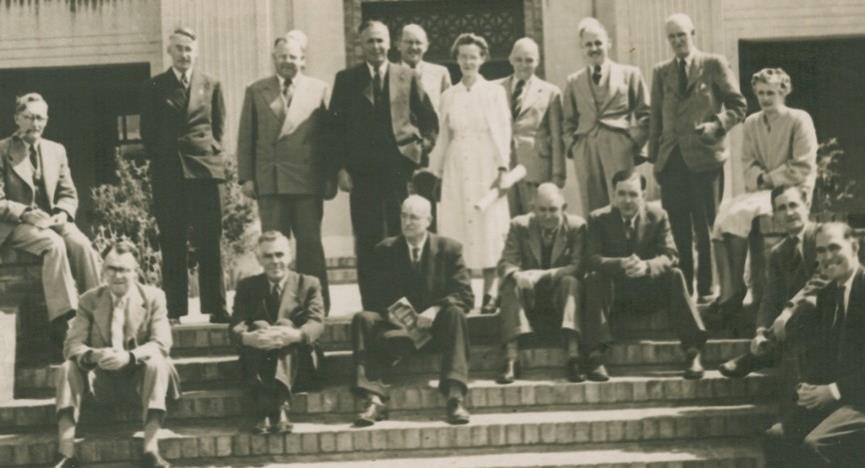
Earliest known photo of the Australasian Association of Psychiatrists. Standing (L–R): F.M.G. Prendegast, D.W.H. Arnott, C.R.D. Brothers, O. Latham, Hospital Matron, J.F. Williams, J.T. Hurt, H.F. Maudsley. Seated, back (L–R): J.O. Paynton, C.I.A. Williams. Seated, front (L–R): R.S. Ellery, C.M. McCarthy, J. Bostock, G.H. Springthorpe, A.J.M. Sinclair, W.J. Freeman, J. Youngman. Photo courtesy V. Youngman
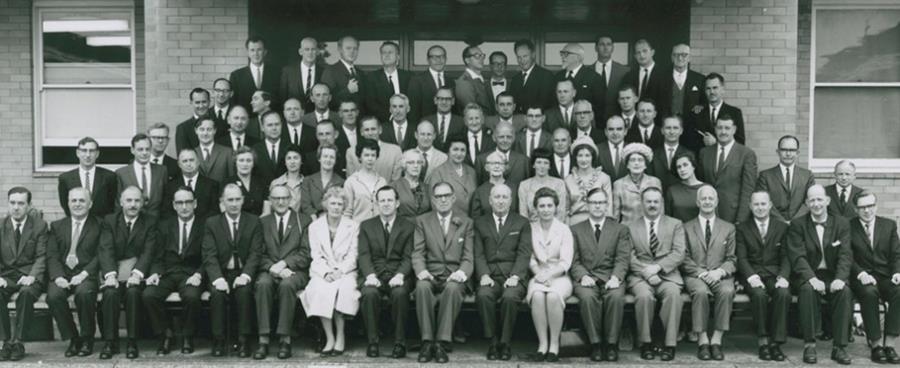 Sydney, 1963
Much has changed since then. Our College now brings together thousands of Fellows and trainees working across Australia and Aotearoa New Zealand, across public and private practice, hospitals and communities, research, education, policy and many different areas of psychiatric practice.
Yet some things have remained remarkably consistent.
One is our responsibility to the next generation. It is visible in every psychiatrist who teaches, supervises and mentors; in every trainee who asks us to think differently; and in the countless conversations between colleagues through which much of our profession is passed from one generation to another.
Another is our responsibility to knowledge.
In 1949, the Association established the Australasian Psychiatric Quarterly Newsletter. This evolved into the Australian Psychiatric Bulletin, and in 1967 the College published the first issue of the Australian and New Zealand Journal of Psychiatry. The Australasian Psychiatry journal followed in 1993.
That tradition of scholarship remains important. Psychiatry must remain grounded in evidence and scientific enquiry, while retaining the intellectual openness to recognise uncertainty, debate ideas respectfully and change our practice as knowledge develops. Our journals, conferences, education and professional networks should help knowledge move beyond our profession – into clinical practice, public understanding, policy and better care.
Our history also asks us to look at ourselves with honesty.
Psychiatry has changed enormously over eight decades: in our science and treatments, in where and how care is provided, in our understanding of culture and identity, and in the place of patients, families, whānau, carers and people with lived and living experience in shaping mental health care.
Some of that change came because people within our profession challenged established thinking. Some came because people outside it challenged us. Both have mattered.
Our early membership reflected the social structures and opportunities of its time. Only three of the original 67 Foundation Members were women. One was Dr Isobel Williams, who went on to become the College’s first female President in 1967. Alongside Dr Christine MacMahon and Dr Irene Sebire, she was among the women helping shape our profession at a time when very few women were able to reach senior positions in medicine.
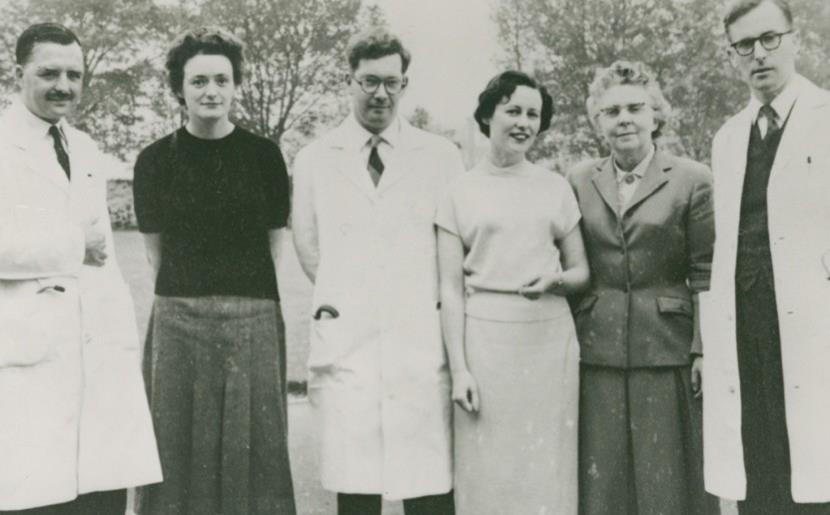 Dr Christine MacMahon, Dr Irene Sebire and Dr Isobel Williams
Our understanding of our responsibilities to Aboriginal and Torres Strait Islander peoples and Māori has also evolved. That history includes areas where psychiatry must acknowledge harm as well as progress. Today, our responsibilities include cultural safety, partnership with communities, supporting Aboriginal, Torres Strait Islander and Māori psychiatrists and trainees, and our commitments to reconciliation and Te Tiriti o Waitangi.
Remembering our history does not require us to view it uncritically. A mature profession should be capable of recognising achievement while also learning from where our knowledge, practice or institutions have fallen short.
Ultimately, however, the history of our College is a history of people: the psychiatrist caring for a patient and family, the supervisor encouraging a trainee, the researcher pursuing an uncertain question, the colleague supporting another, and the people with lived and living experience, families, carers and whānau who have challenged us to see things differently. Most of these contributions will never appear in a history book, but collectively they have shaped our profession.
As we mark 80 years, we are also beginning another chapter. Our Strategic Plan 2026–2030 asks us to build a future-ready College, support a thriving profession, contribute to system leadership and deepen trusted partnerships with communities.
The challenges ahead are significant. Demand for mental health care is growing, our workforce and health systems are under pressure, and science, technology and community expectations continue to evolve. Psychiatry has much to contribute through clinical care, research and education, and through leadership in health systems, public policy and our communities.
I would like us all to use this 80th anniversary as an opportunity to reflect on our profession, our Fellowship and our College.
Over eight decades, thousands of people have shaped who we are today. I invite members to share your reflections and stories: a psychiatrist or colleague who influenced you; a moment in our profession’s history that matters to you; a contribution that deserves to be better known; or simply what being part of this profession and Fellowship has meant to you.
Just as importantly, I would like to hear what you hope we carry forward, and what you believe we should do differently as we shape the next chapter of our College.
These individual stories and reflections are part of our collective history. I hope our 80th year gives us the opportunity not only to remember that history, but to hear from one another and reconnect with what brings us together as a profession.
To all our Fellows, trainees, Affiliates and those who have contributed to psychiatry over these 80 years: thank you.
Together, let us honour what has come before us, and thoughtfully shape what comes next.
Dr Astha Tomar
President
More news & views

President's message
From the President September 2026September has been a month that has brought many aspects of our College together. Across our trainin...
President's message
President’s update: Shaping the future member experienceAs we continue our journey of reform across the College, one of our most important priorities is ens...
President's message
President’s update: Help shape the future of College governanceThere are few opportunities to step back and consider not just how the College works today, but how ...