 RANZCP homepage

The Dean's reflection: October
30 Oct 2026
Rethinking how we develop our supervisors
Overwhelmed, under-recognised and disengaged.
These were the sentiments shared by an experienced clinical educator at the International Conference on Residency Education in Ottawa, Canada earlier this month. The conversation was about supervisor development, or, as it is more commonly described in the medical education literature, faculty development.
It stayed with me.
Clinical supervisors sit at the heart of medical education. Yet we ask a great deal of them: to teach, assess, provide feedback, support trainees experiencing difficulty, create psychologically and culturally safe learning environments, and do all of this alongside the demands of contemporary clinical practice.
So, how do we develop and support supervisors effectively in an increasingly complex and demanding world?
This question is particularly timely. At the International Conference on Residency Education, the latest CanMEDS framework was released, representing its fourth iteration. While its core roles remain, the framework incorporates a range of emerging concepts reflecting the changing realities of clinical practice. These are listed below and, other than indigenous health, are detailed in a series of short papers.
CanMEDS Emerging Concepts
- Adaptive expertise
- Anti-racism
- Artificial intelligence
- The clinical learning environment
- Clinical reasoning
- Complex adaptive systems
- Data-informed medicine
- Equity, diversity, inclusion, and social justice
- Indigenous health
- Physician humanism
- Planetary health
- Virtual care
For psychiatry, this creates both an opportunity and a challenge. We need to consider how these concepts map to our existing curriculum and, importantly, where the gaps lie. To assist with implementation, primers have been developed and further resources including a glossary are available to deepen understandings.
But there is another question.
If our supervisors already feel overwhelmed, is simply providing more training the answer?
What are we already doing?
Supervisor development is a College priority for 2027 and substantial work is already underway.
The Supervisor Development Program is increasingly focused on the practical realities of supervision: improving assessment consistency and calibration, strengthening feedback and constructive conversations, supporting trainees experiencing difficulty, embedding cultural safety and accessibility, and ensuring resources are practical and respectful of supervisors’ time.
Importantly, we are also trying to listen.
The Supervisor Reference Group brings active supervisors together with Stage 3 trainees and Fellows who may not otherwise have formal education roles. It provides a direct supervisor voice into the program, helping to identify priorities, review resources and co-design new materials.
We are also broadening how development can be accessed. A structured Supervisor Learning Path is being developed through Learnit complemented by the supervisor webinar series, the updated Supervisor Handbook and work to co-design practical guidance for culturally safe supervision.
All of these developments are important but are they sufficient?
Probably not. Arguably we need to expand the Faculty development construct.
One of my strongest 'aha' moments at ICRE was being challenged to think differently about what we actually mean by faculty development. Drawing on work presented by Professor Linda Snell, adapted from Professor Yvonne Steinert, faculty development can be understood as something much broader than attending a course, completing a module or participating in a workshop.
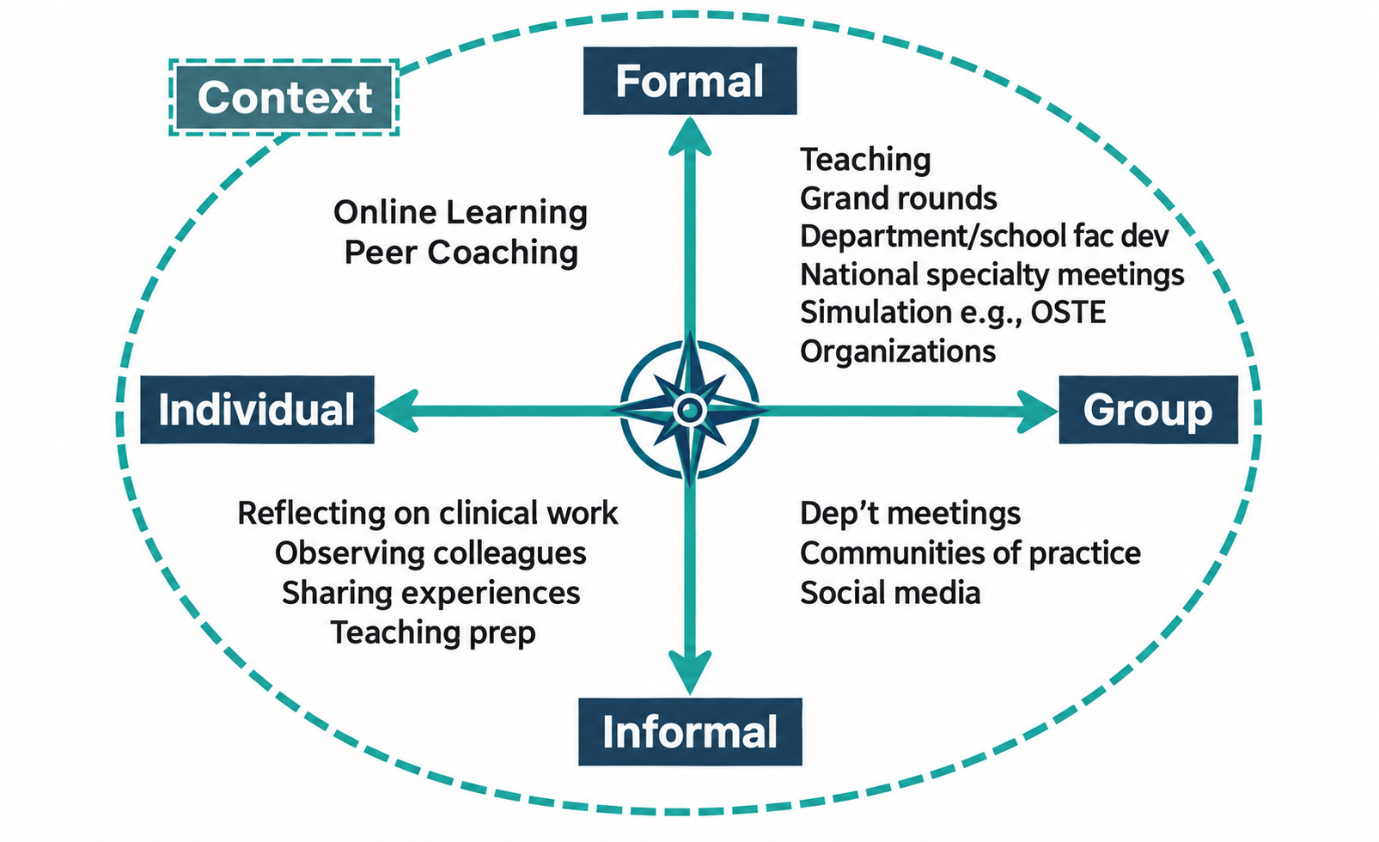 Fig. 1 Expanding the construct of Faculty Development, Snell adapted from Steinert, 2025 (with permission). N.B. represents a North American context
The central proposition is that development happens across a learning ecosystem. It may be formal or informal, individual or collective. It happens through conversations with colleagues, observing others, receiving feedback, reflection on difficult encounters, communities of practice and structured educational opportunities.
In other words training is not synonymous with faculty development.
That distinction matters.
If we think of faculty development simply as training, our response to every new educational challenge can easily become another course, webinar or module.
If, instead, we think about how supervisors themselves learn and develop within their everyday work, different possibilities emerge.
Could we create stronger communities of practice around supervision? Could short podcasts explore the emerging CanMEDS concepts and what they mean specifically for psychiatry and how they can be taught and assessed? Could reflection, peer learning and conversations around challenging supervisory encounters be enhanced as recognised forms of development alongside formal programs?
Most importantly, could we design supervisor development around the reality of the time-poor clinical educator rather than expecting the educator continually to accommodate the centrally led education system?
From more training to a learning ecosystem
Perhaps the question for us therefore needs to change. Instead of asking: 'What more training should we provide our supervisors?' we might ask: 'How do we create an environment in which supervisors themselves can continue to learn the necessary content and how to teach and assess?'
That is a much bigger challenge, but potentially a much more productive one.
Building on last month’s Dean’s Reflection, these small 'aha' moments can change how we think about the art of teaching and learning. If we can make development something that is embedded in clinical practice rather than simply added to it, perhaps we can also begin to address that original challenge: helping our clinical educators feel less overwhelmed, more connected and more engaged.
As always, thank you for supporting the Education programs at the College, and please reach out to continue the conversation at education@ranzcp.org.
Warm regards,
Prof Andy Teodorczuk
Executive Dean of Education