 RANZCP homepage

The Dean's Reflection: November
27 Nov 2026
Celebration, Compassion and Connection
What defines a great team?
This deceptively simple question was at the heart of Project Aristotle, a major research initiative launched by Google in 2012 to understand the “secret sauce” of effective teams. Studying 180 teams, the researchers identified five important characteristics: dependability, structure and clarity, meaning, impact and psychological safety. Perhaps unexpectedly, performance wasn't simply about assembling the cleverest or most technically capable people. How people interacted mattered enormously, and of the five factors, psychological safety emerged as the most important.
Psychological safety can sound rather abstract. In simple terms, it describes an environment in which people feel able to speak up, ask questions, admit mistakes and challenge ideas without fear of embarrassment or punishment.
This has relevance for medical education. Learning inevitably requires us to expose what we don't know, accept feedback, acknowledge uncertainty and sometimes simply say, “I need help.” Yet psychological safety must not be confused with lowering expectations or avoiding accountability.
Indeed, this is where things get interesting. Drawing from the work of Amy Edmondson, high standards without psychological safety risk creating anxiety and silence. Psychological safety without accountability risks creating comfort without growth. The opportunity lies in bringing the two together: creating an environment in which people feel safe enough to speak up, challenge and learn, while remaining accountable for meeting high standards.
As I am fond of saying, there is nothing more practical than good theory.
So, this leaves us with a practical question for the College. If we set the standards, how do we also help support psychologically safe environments in which people can reach them?
Psychological safety cannot simply be mandated. It has to be fostered through our everyday behaviours, relationships and culture.
Which brings me to three simple ideas.
Some years ago, while working as Director of Clinical Training in the prevocational space at The Prince Charles Hospital, we developed an approach to culture centred on three Cs: Celebration, Compassion and Connection.
And as we reach the end of the year, I have been wondering whether those three ideas might offer a useful way of thinking about psychological safety in our own educational community. I recognise this is far from the only approach, nor is it a perfect one, but it is one I would like to share.
The first is Celebration. Earlier in November, I had the privilege of attending the Alice and John Bostock Oration and celebration for the Queensland Branch of the RANZCP. Amid welcoming new Fellows and recognising the contribution of so many colleagues, one moment particularly stayed with me: the presentation of the QPTA Star Supervisor Award to Dr Paula Matich by Dr Mairead O’Callaghan, President of the Queensland Psychiatry Trainees Association.
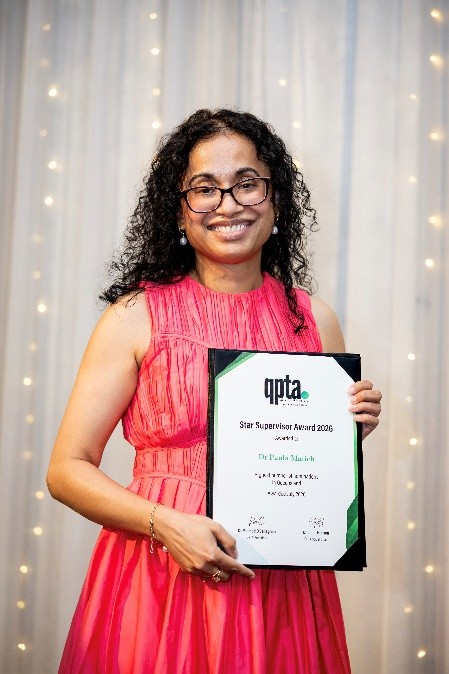
Hearing about Paula's work gave us an opportunity not just to celebrate great supervision, but to ask what made a difference? In medical education we spend considerable time examining problems and responding when things go wrong. Perhaps we should be equally curious about what happens when things go right, and what we can learn from success.
For Paula, we heard that much of the ‘secret sauce’ lay in the warm personal support she offered trainees, creating a space where they could ask questions and acknowledge uncertainty and mistakes without judgement. In addition, she would check proactively on wellbeing, an approach that led to trainees describing her as thoughtful, humane and courageous. Paula is just one example of extraordinary supervision occurring every day across our training program.
At the College, we can write standards, design curricula and refine assessments, but education ultimately comes alive through relationships. It is supervisors who translate much of what we aspire to on paper into the lived experience of our trainees. By celebrating them, recognising the behaviours that make their supervision exceptional and sharing those practices, we reinforce what we value and help create the conditions for psychological safety.
The second C is Compassion. At the ICRE conference last month, I heard Dr Bob Klaber speak about the importance of intentional kindness and compassion in leadership. What struck me was that compassion is not simply a feeling or an act of kindness. It requires us deliberately to notice another person's difficulty, seek to understand their experience, empathise with their struggle and, critically, take action to help.
Those behaviours matter enormously for psychological safety. When compassion becomes part of our everyday leadership and teaching, we create environments in which people are more able to acknowledge uncertainty, admit mistakes, ask for help, seek feedback and challenge assumptions.
But compassion should not be confused with lowering standards. Some of the most compassionate conversations we have in education can also be the most difficult. Compassion is about how we respond when someone is struggling while remaining clear about what is expected of them. Done well, it allows care and accountability, kindness and rigour, psychological safety and high standards to coexist.
The final C is Connection. If celebration gives us energy and compassion sustains us through difficult times, connection helps keep us grounded when the world around us feels uncertain.
Connections are also essential for amplifying voices and building communities. Psychological safety depends not only on being invited to speak, but on believing that when we do, our voice will genuinely be heard. At the College, there is much more we can do to strengthen trainee voice and create the structures and bridges that make those conversations possible.
Next year, we intend to develop new ways for trainees to be heard, questions to be answered and, importantly, for us to be held accountable for what we do in education. As Dean, I will also be convening a series of trainee summits, reaching out and building connections with trainees whose voices may not previously have been heard.
Similarly, with Dr Marshall Watson and Dr Matira Taikato, we hope to strengthen the voices and connections of our Aboriginal and Torres Strait Islander and Māori trainees. One of my personal highlights this year was learning from, and walking alongside, our Indigenous trainees in Alice Springs. There are good foundations here on which we can build.
Ultimately, psychological safety matters because it allows us to draw on the expertise of the people closest to the challenges we are trying to solve. Whether that expertise comes from trainees, supervisors, or our Indigenous communities, our task is not simply to provide the answers. It is to create the conditions in which people feel safe enough to contribute, challenge and help us find better answers together.
As I close my final reflection for the year, thank you for everything you have contributed over the past 12 months. Education is central to the purpose of our College, but the world in which we learn and work is changing, and we need to be willing to change with it.
Perhaps the 3Cs offer us something simple to carry into that changing world: celebrate what is good, practise compassion intentionally and invest in the connections that allow people to flourish. In doing so, we can help create the psychological safety in which people feel able to speak up, learn, challenge and grow.
So, as we head into the festive season, be intentional, be kind to yourselves and to others, and take a moment to celebrate what we have achieved together.
Happy Christmas. I look forward to reconnecting with you in 2027.
Warm wishes to you and your families,
Andrew Teodorczuk
Executive Dean of Education